Recognising a valid invoice in Belgium: 2026 guide

A simple omission on an invoice can be costly. In Belgium, a non-compliant invoice exposes your business to a refusal of VAT deduction, or even a targeted tax audit. This is not just another administrative formality: it is a concrete safeguard for your cash flow and your reputation. The rules have evolved, particularly with the B2B electronic invoicing obligation scheduled for 2026. This guide gives you all the criteria to recognise a valid invoice, avoid common mistakes and stay compliant with Belgian legislation.
Table of contents
- Why invoice validity is crucial for your business
- Mandatory details of a valid invoice in Belgium
- Special cases and exceptions to know
- How to verify the authenticity and compliance of an invoice
- Electronic invoicing in 2026: new standard for B2B
- Simplify compliance with DEMFACT
- Frequently asked questions about invoice validity in Belgium
Key Points
| Point | Details |
|---|---|
| Mandatory details | A valid invoice must include all details required by Belgian law. |
| PEPPOL electronic invoice | For B2B from 2026, only structured electronic invoices sent via PEPPOL are accepted for VAT purposes. |
| VAT verification | Always check the VAT number and numbering sequence to guarantee authenticity and avoid penalties. |
| Exceptions to know | Certain special cases require specific wording and do not allow VAT deduction. |
| Practical tools | Solutions such as DEMFACT make it easy to create compliant invoices and run automatic checks. |
Why invoice validity is crucial for your business
An invoice is more than a payment document. It is a legal supporting document. If it does not comply with the rules of the Belgian VAT Code, the consequences can be immediate and costly.
A non-compliant invoice can prevent the recovery of VAT and increase the risk of audit. For a self-employed professional or an SME, losing the right to deduct VAT on a large transaction can throw an entire quarterly accounting cycle off balance.
The concrete risks of an invalid invoice include:
- Refusal of VAT refund by the tax authorities
- Administrative fines for failing to meet legal obligations
- In-depth tax audits that can go back several years
- Commercial disputes with your customers or suppliers
- Loss of professional credibility
The rules also differ depending on the type of transaction. In B2C, the requirements are lighter for small amounts. In B2B, the level of rigour is total. And from January 2026, B2B electronic invoicing becomes mandatory via the PEPPOL network. Ignoring this change means exposing yourself to risks of invalid invoices that go far beyond a simple fine.
“The compliance of your invoices is not optional: it is the foundation of your tax and commercial protection.”
Mandatory details of a valid invoice in Belgium
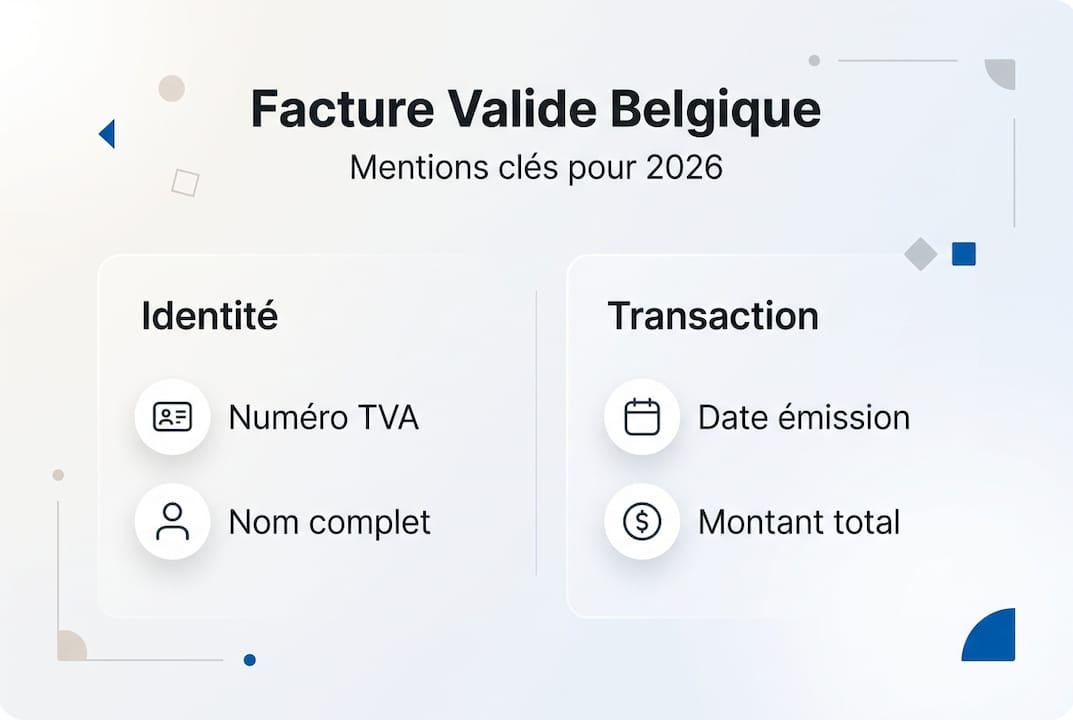
Under the VAT Code and Royal Decree No. 1, every invoice must contain a precise set of information. Here are the essential items:
- Date of issue of the invoice
- Unique sequential number (the sequence must never be interrupted)
- Full name and address of the issuer
- Issuer's VAT number (format BE + 10 digits)
- Full name and address of the customer
- Customer's VAT number (for B2B transactions)
- Precise description of the goods or services supplied
- Date of delivery or performance
- Taxable base, applicable VAT rate and VAT amount
- Total amount including VAT and payment terms
| Detail | Legal purpose | Where to verify it |
|---|---|---|
| Issuer's VAT number | Tax identification | Crossroads Bank for Enterprises (CBE) |
| Sequential number | Accounting traceability | Internal invoice register |
| Description of services | Justification for deduction | Body of the invoice |
| VAT rate and amount | Correct calculation of the tax | Detailed VAT line |
| Date of performance | Relevant tax period | Explicit mention on the invoice |
These mandatory invoice details are non-negotiable. A single missing item can invalidate the entire document.
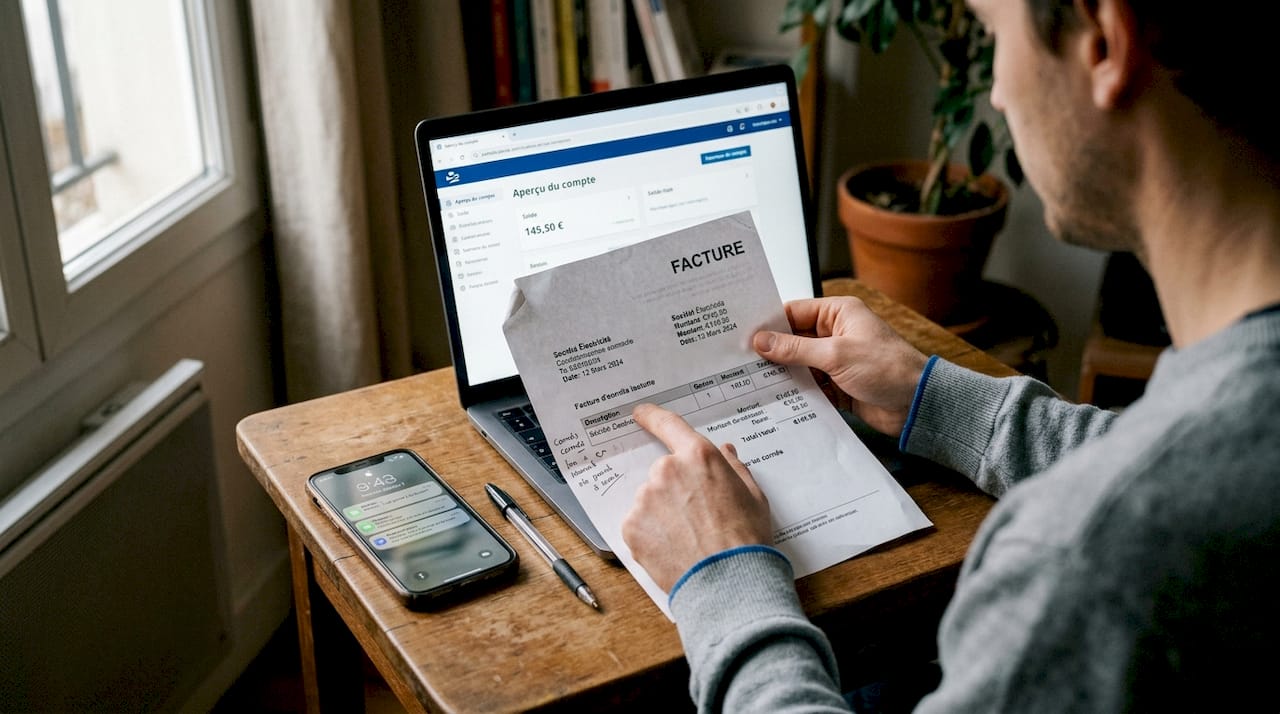
Pro tip: Check the VAT number and the numbering sequence as a priority. These are the two elements most often incorrect during audits. A VAT-compliant invoicing software generates these elements automatically, with no risk of human error.
Special cases and exceptions to know
Not all invoices follow the same model. Certain operations are governed by specific rules that you must master in order to avoid mistakes.
Special cases include simplified invoices, VAT exemption schemes, reverse charge and intra-community operations. Each one has its own requirements.
- Simplified invoice: allowed for amounts under 250 euros excluding VAT. It requires fewer details, but be careful: it does not entitle you to deduct VAT.
- VAT exemption scheme: if you benefit from the exemption scheme, your invoice must carry the specific mandatory wording "Special exemption scheme from the tax". No VAT is applied or recoverable.
- Reverse charge: VAT is shifted to the buyer. The wording "Reverse charge" must appear explicitly on the invoice.
- Intra-community operations: the wording "VAT exemption - Article 39bis" is required, as well as the customer's intra-community VAT number.
| Type of invoice | Special wording | VAT deduction possible |
|---|---|---|
| Standard B2B | All 10 details | Yes |
| Simplified (under 250 euros excl. VAT) | Reduced details | No |
| VAT exemption | Mandatory exemption wording | No |
| Reverse charge | "Reverse charge" wording | Shifted to the buyer |
| Intra-community | Intra-community VAT number + exemption | Subject to EU rules |
Pro tip: Before validating an invoice you have received or issued, first identify the exact nature of the transaction. An intra-community invoice treated as a standard invoice is a frequent mistake during audits. See our guide on the PEPPOL invoice in Belgium for cross-border cases.
How to verify the authenticity and compliance of an invoice
Knowing the rules is not enough. You also need to be able to apply them quickly, invoice by invoice. Here is a step-by-step method.
- Check the issuer's VAT number via the CBE or an online tool. Verification through the CBE confirms the authenticity and integrity of the company's data.
- Check the numbering sequence: the invoice number must be part of an unbroken series. A gap in the numbering is a warning sign.
- Check the date of issue and the date of performance: they must be consistent with the declared tax period.
- Read the description of the services: it must be precise enough to justify the VAT deduction in the event of an audit.
- Calculate the VAT manually: check that the applied rate really matches the nature of the service (6%, 12% or 21%).
- Check the payment terms: deadline, payment method and any late payment penalties.
Pro tip: Use an automated VAT verification tool to save time and reduce human error. VAT compliance software platforms integrate these checks in real time, which is particularly useful if you handle a high volume of invoices.
“An unbroken numbering sequence is one of the first things checked during a tax audit. It is also one of the easiest to fix in advance.”
Electronic invoicing in 2026: new standard for B2B
Compliance is evolving: for B2B, electronic invoicing is becoming unavoidable. Since 1 January 2026, B2B invoices must be structured electronic invoices sent via the PEPPOL network. A PDF invoice sent by email is no longer sufficient.
PEPPOL (Pan-European Public Procurement On-Line) is a standardised network that guarantees four validity criteria:
- Authenticity: the identity of the issuer is certified
- Integrity: the content cannot be modified after sending
- Legibility: the format is standardised and readable by all systems
- Acceptance: the invoice is automatically recognised by the recipient
| Criterion | Paper or PDF invoice | PEPPOL invoice |
|---|---|---|
| Guaranteed authenticity | No | Yes |
| Data integrity | No | Yes |
| Automated processing | No | Yes |
| B2B 2026 compliance | No | Yes |
| Simplified legal archiving | No | Yes |
For SMEs and self-employed professionals, this means adopting a PEPPOL-compatible system before the end of 2025. Our PEPPOL e-invoicing guide explains the concrete steps. If you are still hesitating between PDF and PEPPOL, the difference between PDF and PEPPOL is clearly detailed. And if you work with public institutions, find out how to send an e-invoice to the Belgian government via PEPPOL.
Simplify compliance with DEMFACT
After all these criteria, one practical question remains: how can you make sure every invoice issued or received is compliant, without spending hours on it? That is exactly what DEMFACT solves for Belgian self-employed professionals and SMEs.
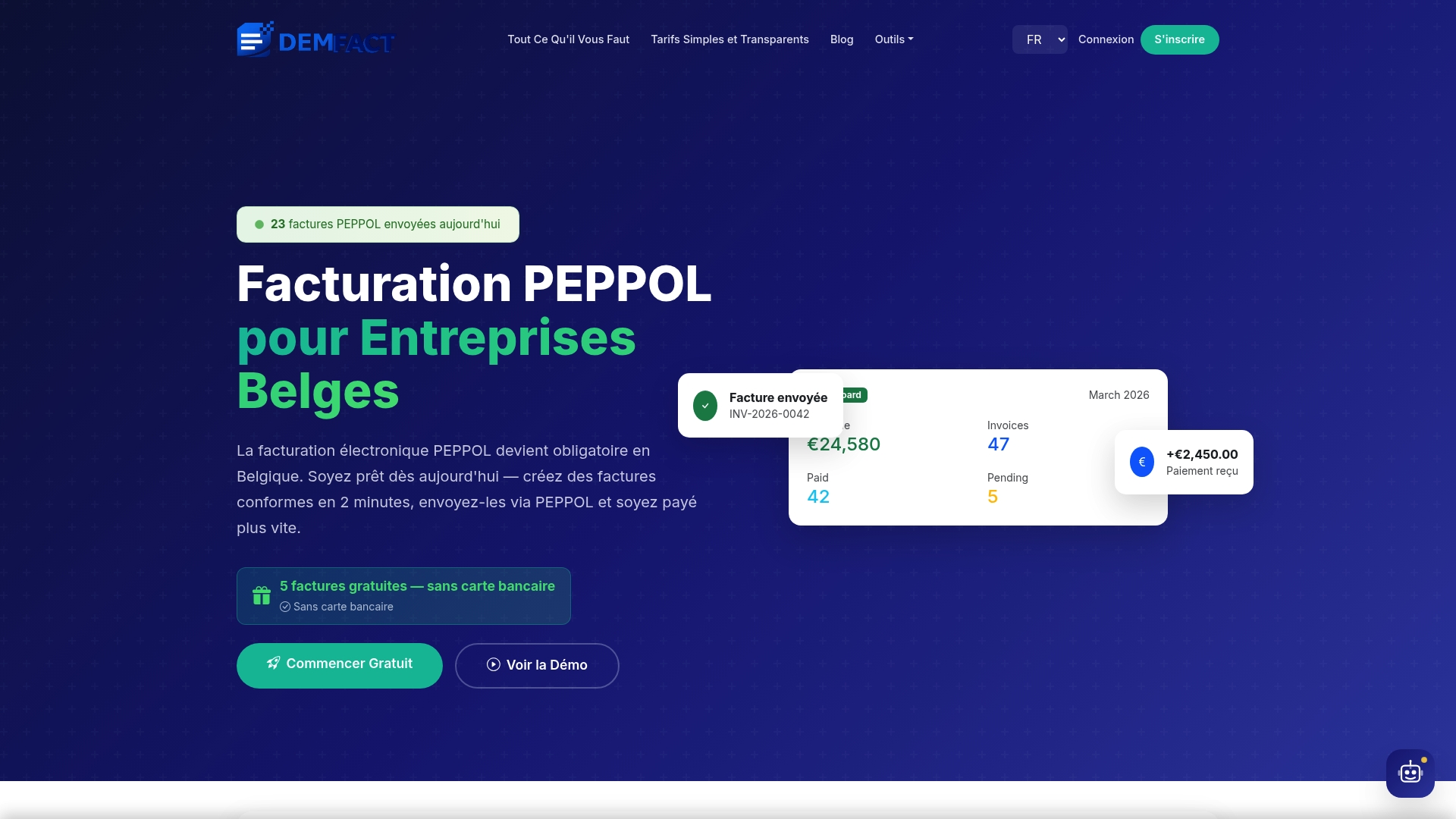
DEMFACT is a Belgian PEPPOL-compliant e-invoicing platform. It automatically generates all mandatory details, checks VAT numbers in real time and connects your business to the PEPPOL network without complex configuration. You issue valid invoices from the very first click. Check out the DEMFACT user guide to discover all the features, or go directly to the DEMFACT professional platform to get started. Compliance has never been so easy to maintain on a daily basis.
Frequently asked questions about invoice validity in Belgium
What are the risks of receiving or issuing an invalid invoice?
You may lose your right to deduct VAT and expose yourself to penalties or a tax audit. The risks include the refusal of a VAT refund and in-depth tax audits.
Is it mandatory to use PEPPOL electronic invoicing for B2B in 2026?
Yes, from January 2026, all B2B invoices must be electronic and sent via PEPPOL in order to deduct VAT. PEPPOL is mandatory for all B2B transactions in Belgium.
How can I quickly check the validity of a VAT number on an invoice?
Use an online tool or consult the CBE to confirm that the number is active and correct. Verification via the CBE is free and instantaneous.
Which details must appear on an invoice for it to be valid?
Every invoice must include the date, the sequential number, the full identities of the issuer and the customer, the description, the price, the VAT amount, the total including VAT and the payment terms. The full list is set out in the Belgian VAT Code.
Does a simplified invoice allow you to recover VAT?
No, a simplified invoice does not entitle you to deduct VAT. It is reserved for transactions under 250 euros excluding VAT and does not contain all the details required for deduction.
Recommended reading
- How to create a PEPPOL invoice for Belgium — Full guide - Belgian Invoicing Platform
- VAT and electronic invoicing in Belgium — full guide - Belgian Invoicing Platform
- What Belgian businesses risk by not using electronic invoicing in 2026 - Belgian Invoicing Platform
- Best invoicing software for Belgian SMEs in 2026 - Belgian Invoicing Platform