Customer invoice management: a method for Belgian SMEs

An invoice sent late, a forgotten follow-up, a client dragging their feet on payment: these commonplace situations can quickly weaken your cash flow and expose you to penalties. In Belgium, requirements around electronic invoicing are evolving fast, and self-employed professionals and small businesses can no longer afford to improvise. This guide provides a concrete, step-by-step method to organise your customer invoice management, remain compliant with Belgian law, and get paid faster. You will master every phase, from creation to archiving, without getting lost in complexity.
Table of contents
- Why structure your customer invoice management?
- What you need before you start
- The step-by-step method for managing your customer invoices
- Anticipating pitfalls and securing your invoice management
- Take action: simplify your invoicing today
- Frequently asked questions on customer invoice management
Key Points
| Point | Details |
|---|---|
| Meet deadlines | Issuing and tracking invoices within the legal deadline protects you against unpaid invoices and penalties. |
| Choose compliant software | Opting for Peppol-certified software makes compliance easier and provides tax benefits. |
| Anticipate technical bugs | Test your tools now to avoid issues when the mandatory switch to electronic invoicing arrives. |
| Automate reminders | Setting up automation reduces the risk of oversight and speeds up customer payments. |
| Legal protection | Contracting upfront and keeping a record of every dispatch protects you in the event of a dispute. |
Why structure your customer invoice management?
An invoice is far more than an administrative document. It is the direct link between your work and your money. When that link is poorly managed, the consequences are immediate: delayed payments, cash flow tensions, and sometimes clients who take advantage of the vagueness to push back their payments.
The concrete risks of an improvised approach are numerous:
- Payment delays that block your ability to pay your own suppliers
- Legal penalties in the event of non-compliance with the new electronic obligations
- Damaged professional image if your reminders are disorganised or late
- Data loss without structured archiving
- Tax risks linked to missing mandatory information
In B2B, the legal rules in Belgium are clear: statutory interest is 11.5% and the flat-rate indemnity of €40 applies automatically in the event of non-payment. This is not an abstract threat; it is the daily reality of many self-employed professionals who have not formalised their reminders.
Beyond payment delays, the non-compliance risks linked to Peppol electronic invoicing (the standardised European network for exchanging invoices) are now unavoidable. Ignoring these obligations means exposing yourself to fines and complications with your VAT returns.
Remember: A solid invoice management method is not a luxury. It is financial and legal protection for your business.
Let's now move on to the prerequisites for getting the method off to a good start.
What you need before you start
Before setting up your system, you need to gather the right tools and the right information. Working without a solid foundation is like building on sand.
The essentials
- Peppol-compliant software: check that it is certified for the Belgian and European network
- Complete client data: VAT number, address, billing details
- Your general terms and conditions of sale (GTCs): drafted, signed, and included in your quotes
- Mandatory legal information: company number, VAT number, bank details
- A deposit policy: define in advance the percentage requested depending on the type of assignment
Comparative table of management tools
| Criterion | Basic software | Peppol-certified platform |
|---|---|---|
| Belgian compliance 2026 | Not guaranteed | Yes |
| Automatic sending | No | Yes |
| Legal archiving | Manual | Automatic |
| Possible tax deduction | Partial | 120% |
| Accounting integration | Limited | Complete |
Taxation and e-invoicing offer a concrete advantage: the law provides for a 120% deduction on subscriptions to invoicing software and 20% for digital investments from 2025. In other words, your software costs you less than you think.
Consult our Peppol electronic invoicing guide to choose the solution suited to your situation. And before you get started, read up on the mistakes to avoid so as not to waste time on costly corrections.
Pro tip: Check the solvency of new clients before accepting a major assignment. A simple extract from the Crossroads Bank for Enterprises can save you plenty of unpleasant surprises.
Now equipped, let's discover the step-by-step method for effectively managing your customer invoices.

The step-by-step method for managing your customer invoices
Here is the sequence to follow for every invoice, without exception. Consistency is your best ally.
-
Prepare and check the invoice: mandatory sequential numbering, issue date, due date, precise description of services, amounts excluding VAT and VAT, complete legal information. Consult our guide to create a compliant Peppol invoice on the first attempt.
-
Choose the right sending channel: from 2026, B2B exchanges between Belgian VAT-registered parties must go through the Peppol network. Understand the difference between PDF versus Peppol so you don't send a document that will not be legally recognised.
-
Send and keep the proof: your platform must generate an acknowledgement of receipt. Without this proof, you cannot demonstrate that the invoice was properly transmitted in the event of a dispute. Our article on sending Peppol e-invoices details this step.
-
Automate your reminders: schedule a reminder 3 days before the due date, then at day+1, day+7 and day+15 in the event of non-payment. A professional but firm tone from the first reminder.
-
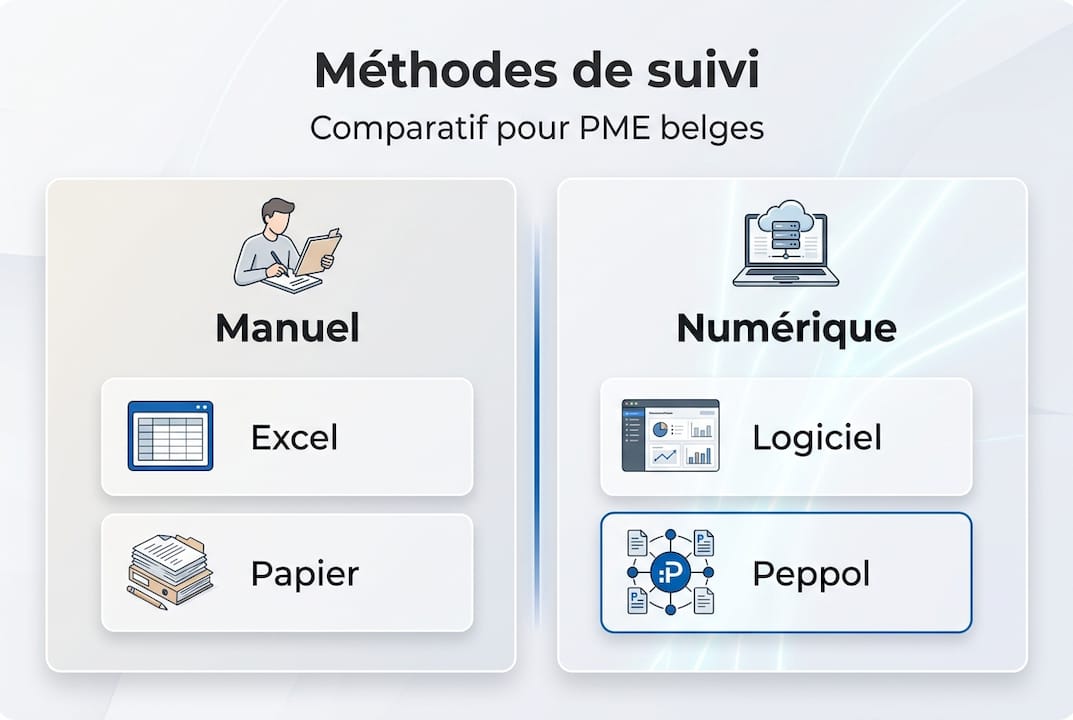
Centralise the follow-up: use a single dashboard to view issued, pending, paid and overdue invoices. No scattered Excel files.
-
Archive by the book: in Belgium, invoices must be kept for 7 years. Your software must guarantee the integrity and accessibility of the documents.
Comparison of tracking methods
| Method | Weekly time | Risk of error | Compliance 2026 |
|---|---|---|---|
| Manual Excel file | 3 to 5 hours | High | No |
| Basic software | 1 to 2 hours | Medium | Partial |
| Integrated Peppol platform | Less than 30 min | Low | Total |
Warning: fines of €1,500 to €5,000 per non-compliance apply after the 2026 tolerance period. Testing your solution now means avoiding an unpleasant surprise at the worst possible moment.
Pro tip: Never create two invoices with the same number, even to correct an error. Issue a credit note, then a new invoice with the next number in the sequence.
Even when applying a method, beware of technical and legal pitfalls. Let's see how to avoid them.
Anticipating pitfalls and securing your invoice management
The method is in place, but incidents can still occur. It is better to anticipate them than to suffer them.
The most frequent issues in Peppol electronic invoicing:
- Invoices not received by the recipient despite confirmed sending
- Unreadable XML files or rejected by the client's platform
- Missing acknowledgements of receipt that weaken your proof of dispatch
- Ignored software updates that create incompatibilities
- Missing or unsigned GTCs that weaken your position in the event of a dispute
According to an analysis of frequent bugs on Peppol, persistent Peppol bugs such as unreceived invoices and unreadable XML files can affect your VAT returns and your proof of dispatch. Advance contracting is essential to secure each transaction.
Best practice: Include a clause in your contracts specifying the accepted invoicing channel (Peppol), the payment deadline, and the applicable penalties. This avoids any ambiguity and reinforces your legal position.
To go further, consult our guide on common Peppol mistakes and discover how to strengthen the security of e-invoices in your day-to-day operations.
Train yourself and your team now. Waiting for the regulatory deadline to test your system means taking an unnecessary risk. Certified platforms allow you to test in a live environment before going into production.
Take action: simplify your invoicing today
You now have a clear view of every step, the tools required, and the pitfalls to avoid. The logical next step is to centralise all of this in a solution that does the work for you.
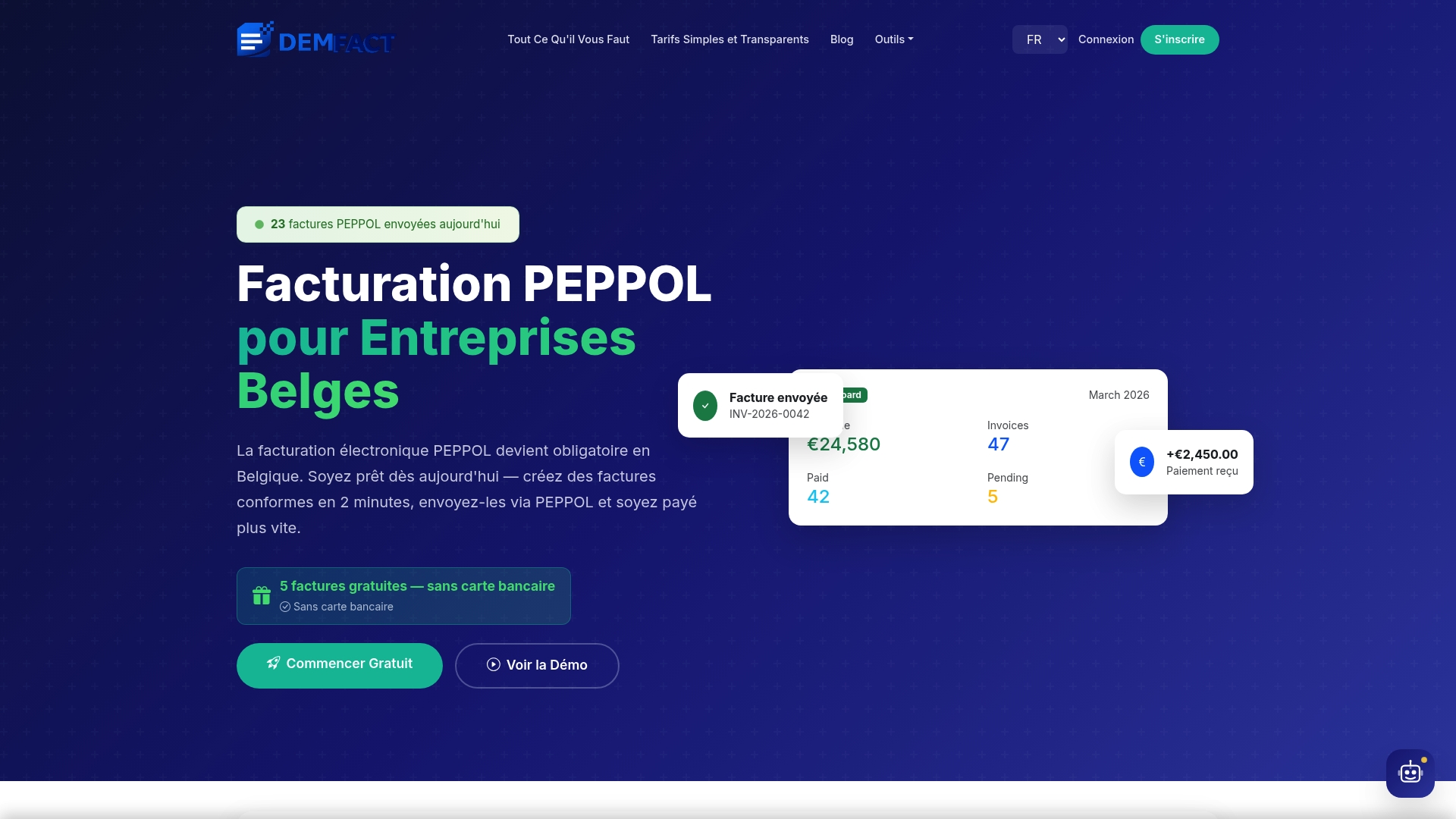
The DEMFACT platform is designed specifically for Belgian self-employed professionals and SMEs. It integrates issuing, sending via the Peppol network, automated reminders and compliant archiving, all in a simple interface. No need to be an accounting or IT expert. Follow the using DEMFACT guide to get started in just a few minutes. If you work with an accountant, the solution for accountants makes collaboration and document sharing easier. Test it with no commitment and get ahead of the 2026 obligations.
Frequently asked questions on customer invoice management
What are the deadlines and penalties in the event of late payment between businesses?
In B2B, the legal deadline is 30 days; automatic interest is 11.5% and the minimum penalty is €40. Send progressive reminders before issuing a formal notice of default.
What tax benefits does electronic invoicing offer in Belgium?
The law provides for a 120% tax deduction for invoicing software and 20% for digital investments from 2025. This is a solid financial argument for quickly adopting a certified platform.
How can I avoid bugs when receiving electronic invoices via Peppol?
Test your solution before the deadline, formalise the sending conditions in a contract, and monitor every XML anomaly or missing acknowledgement so you can react quickly.
What best practices help guarantee fast payments?
Check the solvency of your clients, ask for a deposit, draft clear and signed GTCs, and automate your reminders to shorten your collection times.
Recommendation
- Best invoicing software for Belgian SMEs in 2026 - Belgian Invoicing Platform
- How to create a PEPPOL invoice for Belgium — Complete guide - Belgian Invoicing Platform
- Belgian VAT-compliant invoicing software — What you need to know - Belgian Invoicing Platform
- VAT and electronic invoicing in Belgium — complete guide - Belgian Invoicing Platform